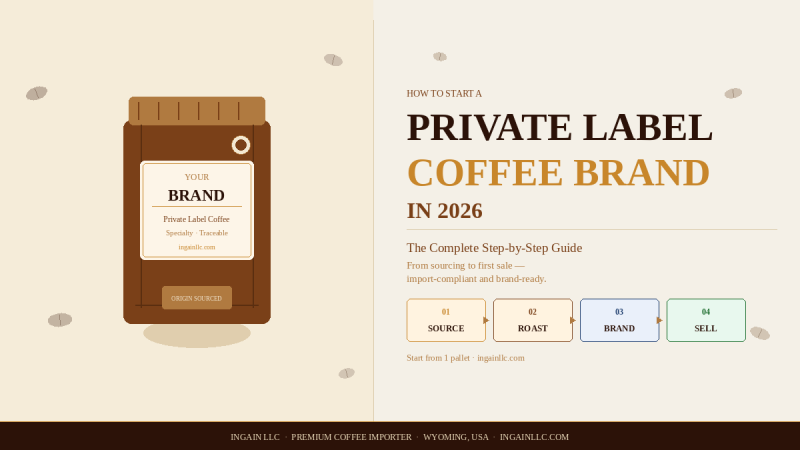
By InGain LLC — Your IOR-Managed Coffee Import & Private Label Partner
You've seen it everywhere. A sleek matte-black bag. A clean logo. A compelling origin story. A coffee brand that looks like it belongs on the shelves of a specialty grocer — but ships from a small operation that started with one pallet of Ethiopian natural.
That could be you.
Private label coffee is one of the most accessible product businesses you can launch in 2026. Margins are real. Demand is growing. Entry barriers are lower than most people realise — if you know the right steps and the right partners.
InGain LLC works with roasters, café chains, online sellers, and first-time entrepreneurs to launch private label coffee brands starting from just 1 pallet. Our FSPCA-certified team handles import compliance, and we help you move from idea to shelf-ready product.
What Is Private Label Coffee — And Why 2026 Is the Right Moment
Private label coffee means sourcing coffee from a supplier, packaging it under your own brand name, and selling it as your product. You control the positioning, pricing, packaging, and story.
Why now? A few converging forces make 2026 particularly strong for private label coffee launches:
- Consumer demand for "discovery" coffee is at an all-time high. Subscription boxes, specialty cafés, and social-media-driven food culture have trained consumers to seek out new, story-rich coffee brands. They're not brand-loyal to the big names the way they were a decade ago.
- The barrier to entry has dropped significantly. Toll roasters, co-packers, and import partners like InGain LLC make it possible to launch with a fraction of the capital required five years ago.
- Online marketplaces have matured. Amazon's grocery and gourmet food category is a legitimate channel for specialty coffee brands. Shopify, DTC email, and subscription models have levelled the distribution playing field.
- Origin storytelling is a competitive advantage. A bag that says "Single-Origin Indian Robusta, Anamalai Hills, Coorg" tells a story that a generic "dark roast" never can.
Step 1: Define Your Brand Before You Touch a Bean
The biggest mistake first-time private label coffee founders make is jumping straight to the product. Brand-first. Always.
Answer these questions before spending a single dollar on sourcing:
- Who is your customer? Be specific. "Coffee lovers" is not a customer. "Specialty coffee drinkers aged 28–45 who buy online and care about origin transparency" is a customer. "Café owners who want a consistent house blend for their back bar" is a customer.
- What is your positioning? Are you competing on origin (single-estate, traceable, Q-graded)? On flavour profile? On cause (farmer-direct, sustainability)? On price-value?
- What is your brand personality? Minimal and modern? Rustic and artisanal? Bold and energetic? Your packaging, typography, and copy all flow from this.
- What's your channel? DTC website? Amazon? Wholesale to cafés? Subscription? Corporate gifting? Each channel shapes your bag sizes, labelling requirements, and pricing architecture.
Step 2: Choose Your Coffee Origin and Profile
Here is a practical guide to the origins InGain LLC sources, and what they're best suited for in a private label context:
- Indian Robusta (Coorg, Chikmagalur, Bababudangiri) — Dense, chocolatey, low-acid, with a thick crema. Exceptional for espresso blends and dark roasts. Underpriced relative to quality. Indian Robusta is the backbone of countless major European espresso blends — yet barely marketed in the US, giving your brand genuine differentiation. Explore Indian Robusta →
- Indian Arabica (Monsoon Malabar, Coorg AA) — Monsoon Malabar is one of the most distinctive coffees in the world. Low acidity, earthiness, and a full body unlike anything from Latin America or Africa. A conversation-starting origin for specialty brands that want to stand out. [See: Why US Roasters Are Discovering Indian Monsoon Malabar — add link when post is live]
- Vietnamese Robusta — High-yield, consistent, extremely cost-effective for blends and cold brew concentrate. If your brand is targeting high-volume café accounts, subscription bundles, or price-competitive Amazon listings, Vietnamese Robusta at scale is where your margin lives. Explore Vietnam Robusta →
- Ethiopian Natural and Washed (Yirgacheffe, Sidama, Guji) — The spiritual home of coffee. The gold standard for specialty, light roast, and single-origin storytelling. A Q-graded Ethiopian natural from Yirgacheffe — blueberry, jasmine, wine — practically writes its own product description. Explore Ethiopian Coffee →
- Burundi (Kayanza, Ngozi) — The emerging origin story in 2026. Complex, bright, stone-fruit-forward washed coffees. Underrepresented in the US market relative to quality.
Practical rule: start with one origin and nail it. Request samples before committing. Get Q-grade documentation if you're positioning as specialty (84+ score). Confirm your supplier has FDA facility registration and a DUNS number — your import compliance depends on it.
Step 3: Understand Your Sourcing Options — Green vs. Roasted Import
- Option A: Import green coffee and toll roast domestically — You import green beans, then contract with a US toll roaster to roast to your spec. Maximum quality control, access to the widest range of specialty lots, and usually better margin at scale. InGain LLC acts as your Importer of Record (IOR), handles ISF, CBP entry, Prior Notice, and provides FSVP guidance so your compliance infrastructure is solid from day one.
- Option B: Import roasted coffee — Roasted coffee deteriorates faster than green, making ocean freight logistics more challenging. FDA labelling requirements apply in full. FSVP obligations still exist for the US importer.
- Option C: Source domestically — You buy green coffee from InGain LLC as a US seller, then toll roast and brand it yourself without holding the import obligations. Suitable for brands in early stages who want to move fast.
Step 4: FDA Labelling Compliance for Coffee — What Your Bag Must Say
FDA labelling violations can result in product seizure, import refusal, or marketplace delisting. These elements are mandatory:
- Statement of Identity: The product must be clearly identified on the principal display panel — "Coffee," "Ground Coffee," "Whole Bean Coffee," etc.
- Net Quantity of Contents: Required on the front of the bag, bottom 30% of the panel. Must include both metric (grams) and US customary (ounces) units.
- Nutrition Facts Panel: Yes, coffee requires one. Black coffee is essentially zero calories and zero macros, but the panel is legally required.
- Ingredient Statement: For pure coffee with no additives, this is simply: "Coffee."
- Name and Address: Your brand name and a US address must appear on the label. If you are not the manufacturer: "Distributed by [Your Brand], [City, State, ZIP]."
- Country of Origin: Not federally mandated for coffee, but strongly recommended — especially if origin is part of your brand story.
- Roast/Best By Date: No federal law mandates a roast date, but Amazon requires it. Recommended: Best By date 9–12 months from roast date for whole bean; 6–9 months for ground.
- Barcode (UPC/EAN): Required for retail distribution and mandatory for Amazon. Purchase from gs1us.org — not from third-party resellers, which can cause GTIN conflicts.
Step 5: Design Your Packaging
Your packaging is your primary marketing asset — especially in the online channel where the consumer can't smell or touch the product.
- Bag format: Stand-up pouch with tin-tie (specialty market standard), stand-up pouch with ziplock (larger sizes), flat-bottom quad-seal bag (premium shelf presence), or side-gusset kraft bag (classic artisan aesthetic).
- Bag material: Kraft-laminate with a matte finish reads as premium and artisanal. Glossy bags read as mass-market. Foil-lined bags extend shelf life.
- Degassing valve: Non-negotiable for freshly roasted coffee. The CO₂ released after roasting will burst a sealed bag without a one-way valve.
- Minimum print runs: Digital bag printing via suppliers like Roastar, Packlane, or PrintFresh allows runs as small as 50–100 bags — ideal for testing before committing to 5,000-unit offset print runs.
Step 6: Work Out Your Numbers - Pricing, Margins, and MOQs
Private label coffee is a margin business. Typical cost components for the green coffee + toll roast + packaging model:
Cost Component
Approximate Range
Green coffee (FOB origin)
$4.40–$14.00/kg depending on origin and grade (consider market fluctuations)
Ocean freight (LCL, per kg est.)
$0.40–$0.80/kg
Import duties
0% on green coffee (HTS 0901.11)
IOR / customs clearance
$150–$400 per shipment (spread across volume)
Toll roasting fee
$0.80–$1.50/lb roasted
Packaging (per bag, digital print)
$0.80–$2.00 per bag depending on size and quantity
Label design (one-time)
$500–$2,500 depending on designer
Fulfilment (per order)
$4–$8 for DTC; Amazon FBA fees vary
Working example — 12 oz bag of Ethiopian natural, specialty grade:
- Green coffee cost landed in US: ~$4.50/lb
- Roasting loss (~15–18%): effective cost becomes ~$5.40/lb roasted
- Toll roast fee: ~$1.10/lb
- Packaging (12 oz bag): ~$1.20
- Total COGS per 12 oz bag: approximately $7.00–$8.50
- Retail price target: $18–$22 (specialty positioning)
- Gross margin: 55–62% — strong for a food product
InGain LLC starts from 1 pallet — approximately 1,200–1,500 kg of green coffee, yielding roughly 2,900–3,600 units at 12 oz per bag. A manageable first production run.
Step 7: Build Your Sales Channel
- Direct-to-Consumer (DTC) via Shopify or your own website: Highest-margin channel. You own the customer relationship. Subscription models dramatically improve LTV.
- Amazon: The largest discovery channel for coffee in the US. Requires UPC/EAN barcode, Nutrition Facts panel, Best By date, and FDA-compliant labelling. An optimized listing with A+ content is table stakes.
- Wholesale to Cafés: Café owners constantly seek differentiated offerings. Focus on independent specialty cafés first — they make buying decisions faster than chains and value story more than price.
- Corporate Gifting and B2B: Often overlooked. A premium private label coffee gift set has a strong price-to-perceived-value ratio. Corporate clients ordering 50–500 units at a time represent significant revenue.
Step 8: Get Your Import Compliance Right From the Start
If you are importing green coffee directly from origin, you need to understand your compliance obligations. The key framework is FSVP (Foreign Supplier Verification Program), part of FDA's FSMA regulations.
As the US owner or consignee of an imported food shipment, you are the FSVP importer. You must:
- Conduct and document a hazard analysis for your coffee and supplier
- Verify your foreign supplier's food safety practices on an ongoing basis
- Maintain records for a minimum of two years
- Have your supplier's DUNS number in your CBP entry filing
- Ensure your supplier holds an active FDA facility registration
For the full FSVP guide, see: What Is FSVP and Why Every US Coffee Importer Must Comply →
For a full walkthrough of the CBP entry process, see: How to Import Coffee to the USA: Complete FDA & CBP Guide →
Step 9: Launch, Test, Iterate
Your first batch is not your final product. It's your research instrument. Send samples to food bloggers and specialty coffee accounts. Launch a small Amazon listing with 200 units and measure click-through rate, conversion, and review velocity. Offer your first 50 customers a discount in exchange for honest feedback. Cup every batch against your quality benchmark.
The private label coffee brands that scale successfully treat their first production run as a test, not a commitment. They launch lean, listen aggressively, and iterate quickly on flavor profile, packaging, pricing, and messaging.
Why Private Label Coffee Brands Choose InGain LLC
We built InGain LLC specifically for people in your position: launching something real, sourcing at an honest scale, and needing compliance handled professionally without enterprise-level fees.
- Multi-origin sourcing — India (Robusta, Arabica, Monsoon Malabar), Vietnam (Robusta), Ethiopia (Yirgacheffe, Sidama, Guji), Burundi (Kayanza, Ngozi). All suppliers FDA-registered, DUNS-verified, and audited.
- Starting from 1 pallet — No pressure to commit to a full container before you've validated your market.
- IOR-managed import — We handle ISF, CBP entry, customs bond, and FDA Prior Notice on every shipment.
- FSVP guidance — Our FSPCA-certified founder personally supports your compliance posture.
- Samples available — Request green coffee samples before committing to a production run.
- Transparent pricing — No hidden fees, no volume pressure, no bait-and-switch minimum orders.
Your Private Label Coffee Launch Checklist
- ☐ Brand brief documented (customer, positioning, channel, personality)
- ☐ Origin and coffee profile selected; samples cupped and approved
- ☐ Toll roaster or co-packer identified and contracted
- ☐ Bag format and size decided; packaging supplier quotes obtained
- ☐ Label design complete with all FDA-required elements
- ☐ GS1 UPC barcode purchased (if selling retail or on Amazon)
- ☐ Nutrition Facts panel generated (FDA-compliant format)
- ☐ US address secured for label distributor line
- ☐ FSVP obligations understood; hazard analysis documented
- ☐ IOR partner confirmed (InGain LLC or alternative)
- ☐ Sales channel live (Shopify store, Amazon listing, or wholesale deck)
- ☐ First production run quantity planned against your cost model
Ready to Launch Your Brand?
The best private label coffee brands in 2026 are not the ones with the biggest budgets. They're the ones with the clearest positioning, the most compelling origin story, and the right sourcing and compliance partner behind them.
InGain LLC is that partner.
Request Green Coffee Samples →
Explore Our Private Label Service →
Related Reading
InGain LLC is a Wyoming-registered coffee importer and Importer of Record (IOR) specializing in green coffee sourcing and private label support for US roasters, brands, and entrepreneurs. This article is for informational purposes only and does not constitute legal or regulatory advice.
Add comment
Comments