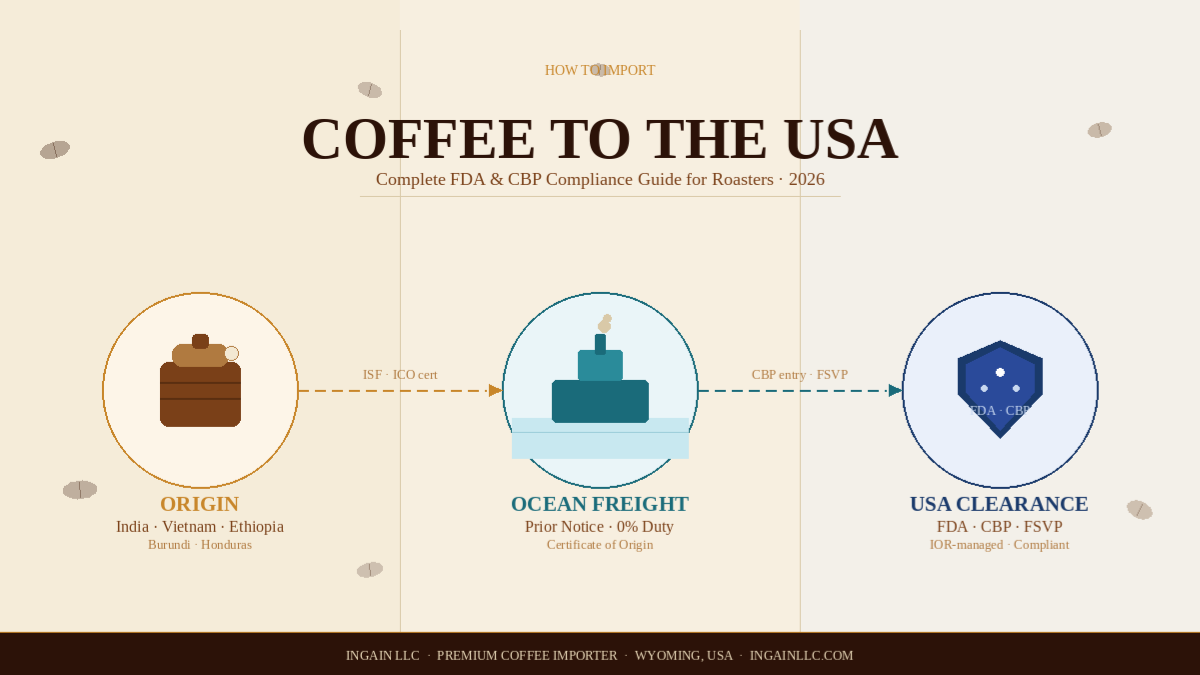
By InGain LLC — Your IOR-Managed Coffee Import Partner
You found a stunning lot. An Indian Robusta from Coorg with the body your espresso blend has been missing. A natural Ethiopian from Yirgacheffe that cupped at 87 points. A Vietnamese Robusta priced perfectly for your cold brew concentrate line.
If you've never imported green coffee into the United States before — or if you have, but you've been winging it — this guide is for you. We'll walk through every agency, every form, every deadline, and every compliance obligation that stands between your origin coffee and your roastery.
At InGain LLC, we act as your Importer of Record (IOR) and provide FSVP guidance through our FSPCA-certified team. This guide reflects what we do for our customers every day.
Who Regulates Coffee Imports into the USA?
Three federal agencies have jurisdiction over imported coffee. Understanding who does what prevents costly mistakes.
- S. Customs and Border Protection (CBP) — Controls the physical and administrative entry of all goods into the United States. CBP enforces trade laws, collects duties and fees, and processes your entry documentation. Every coffee shipment — regardless of size — passes through CBP.
- The U.S. Food and Drug Administration (FDA) — Regulates coffee as a food product under the Federal Food, Drug, and Cosmetic Act (FDCA) and the Food Safety Modernization Act (FSMA). The FDA ensures your coffee is safe for human consumption, free from harmful contaminants, and properly documented at the supplier level.
- The U.S. Department of Agriculture (USDA) — Enters the picture primarily if you are importing organic-certified coffee. The USDA's National Organic Program (NOP) requires proof of accredited organic certification from the exporting country. For conventional green coffee, USDA involvement is minimal.
Step 1: Classify Your Coffee Correctly (HTS Codes)
Before anything else, you need the right Harmonized Tariff Schedule (HTS) code. This determines your duty rate, your documentation requirements, and how CBP processes your entry.
Product
HTS Code
Import Duty
Green coffee, not decaffeinated
0901.11.0000
0%
Green coffee, decaffeinated
0901.12.0000
0%
Roasted coffee, not decaffeinated
0901.21.0015
0%
Roasted coffee, decaffeinated
0901.22.0000
0%
The good news for roasters: Green coffee carries a 0% import duty regardless of origin — India, Vietnam, Ethiopia, Burundi, or anywhere else.
Step 2: Ensure Your Supplier Is FDA-Registered
Under the FDA's Bioterrorism Act and reinforced by FSMA, every foreign facility that manufactures, processes, packs, or holds food for U.S. consumption must be registered with the FDA. Your green coffee supplier — the mill, the washing station, the exporter — must have an active FDA facility registration.
If the registration is missing or expired at the time of arrival, CBP and FDA can detain, refuse, or return your shipment. Penalties are also possible.
- Request FDA registration confirmation from your supplier before placing your first order.
- Confirm the registration number is current (FDA registrations must be renewed every two years, in even-numbered years).
- Keep this documentation in your records.
Step 3: File Prior Notice with the FDA
The FDA requires Prior Notice for every commercial food shipment entering the United States — including green coffee. It gives the agency time to review the shipment before it clears customs.
Mode of Transport
Prior Notice Deadline
Ocean vessel
At least 8 hours before arrival
Air freight
At least 4 hours before arrival
Rail
At least 8 hours before arrival
Truck (road)
At least 2 hours before arrival
Step 4: File the Importer Security Filing (ISF) — Ocean Shipments Only
If your coffee is arriving by ocean vessel, you must file an Importer Security Filing (ISF), also known as "10+2," with CBP.
Critical deadline: ISF must be filed no later than 24 hours before the vessel departs the last foreign port. Late or missing ISF filings can result in fines of up to $5,000 per violation.
Step 5: Understand the CBP Entry Process
For shipments valued over $2,500, a formal entry is required. This involves: CBP Entry Form, commercial invoice, packing list, bill of lading, Certificate of Origin, and any other relevant certificates. A customs bond is mandatory for formal entries.
Step 6: Comply with FSVP — The Requirement Most Roasters Miss
This is the section that gets importers into trouble. FSVP is complex enough to warrant its own dedicated guide:
What Is FSVP and Why Every US Coffee Importer Must Comply — Full Guide →
The Foreign Supplier Verification Program (FSVP), part of FSMA (21 CFR Part 1, Subpart L), requires that any U.S. importer of food verify that their foreign suppliers are producing food in a manner consistent with U.S. food safety standards. If you are the U.S. owner or consignee of an imported food shipment — you are the FSVP importer. This cannot be delegated away.
- Hazard Analysis: Evaluate biological (Salmonella, mycotoxins like Ochratoxin A), chemical (pesticides, heavy metals), and physical hazards for each supplier. Document everything.
- Supplier Evaluation: Evaluate your supplier's food safety performance and the risk posed by their coffee.
- Supplier Verification Activities: Conduct ongoing verification: onsite audits, sampling/testing, or review of food safety certifications.
- Corrective Actions: If a verification reveals a problem, take prompt corrective action — including stopping imports if necessary.
- FSVP Records: Maintain all documentation for at least two years, available to FDA within 24 hours upon request.
- DUNS Number (since July 2022): Your foreign supplier's DUNS number must appear in your CBP entry filing. This is a hard requirement.
Important: The FSVP importer and the CBP Importer of Record are NOT the same entity. A customs broker or freight forwarder clearing your goods does NOT assume your FSVP obligations. You do.
Step 7: Obtain a Certificate of Origin (ICO)
The International Coffee Organization (ICO) requires a Certificate of Origin for all commercial coffee exports. Your supplier is responsible for obtaining it. Make it a standard requirement in your purchase agreement.
Step 8: Arrange Logistics and Insurance
Green coffee is typically shipped in jute or GrainPro bags (60 kg per bag) or supersacks (500–1,000 kg). For small roasteries starting out, LCL shipments from 1 pallet (approximately 1,200–1,500 kg) are a practical entry point — exactly the minimum InGain LLC offers. Cargo insurance is strongly recommended.
Common Mistakes First-Time Coffee Importers Make
- Skipping FSVP because you used a broker — using a customs broker does not transfer your FSVP obligations.
- Not verifying FDA supplier registration before ordering — discovering this after the shipment is on the water is expensive.
- Missing the ISF deadline — it must be filed before the vessel departs the last foreign port.
- No hazard analysis on file — "We trust our supplier" is not a compliant answer during an FDA audit.
- Ignoring the DUNS number requirement — since July 2022, this triggers FDA flags if missing.
The IOR Model: How InGain LLC Makes This Simpler
For roasters and brands who want to source direct-from-origin coffee without building an in-house compliance infrastructure, working with an Importer of Record (IOR) is the most practical path.
- InGain LLC Files all CBP entry documentation (ISF, entry forms, customs bonds).
- InGain LLC Submits FDA Prior Notice for every shipment.
- InGain LLC Handles all communication with CBP and FDA at the port of entry.
- InGain LLC Sources from FDA-registered, DUNS-verified suppliers in India, Vietnam, Ethiopia, and Burundi.
- InGain LLC Provides FSVP guidance through our FSPCA-certified team.
You can start from just 1 pallet. No long-term volume commitments. No opaque pricing.
Your Coffee Import Compliance Checklist
For a more comprehensive 15-point version, see:
Coffee Import Compliance Checklist: 15 Things Your Importer Should Be Doing →
- ☐ Correct HTS code identified (0901.11.0000 for green non-decaf)
- ☐ Foreign supplier has active FDA facility registration
- ☐ Supplier's DUNS number obtained and documented
- ☐ FSVP hazard analysis completed for this food and supplier
- ☐ FSVP verification plan established
- ☐ Certificate of Origin confirmed with supplier
- ☐ Licensed customs broker or IOR engaged
- ☐ Customs bond in place (single-entry or continuous)
- ☐ ISF filed before vessel departure from last foreign port
- ☐ FDA Prior Notice filed per modal deadline
- ☐ Cargo insurance arranged
Ready to Import — Without the Compliance Headache?
At InGain LLC, we've built our entire operation around making this process simple, transparent, and compliant for US roasters, private label brands, cafes, wholesalers, and marketplace sellers.
Start with a sample. Scale at your pace. Import with confidence.
Related Reading
- What Is FSVP and Why Every US Coffee Importer Must Comply →
Add comment
Comments